

It’s a scene played out in thousands of family homes every evening: your child is struggling through homework, they rub their eyes frequently, or they’re tilting their head at a strange angle just to focus on a screen. As parents, we often attribute these signs to fatigue, screen time, or even a simple lack of effort. We couldn’t be more wrong. These subtle cues are often the clearest signals that a child needs specialized care—the kind only a pediatric ophthalmologist can provide.
Pediatric Ophthalmology is more than just a medical specialty; it is the field responsible for safeguarding a child’s entire visual future. Unlike general eye doctors, these specialists focus exclusively on the development of the visual system and the unique diseases that affect children, from newborns to teens. Why is this distinction crucial? Because a child’s eyes are not just smaller versions of adult eyes. Their entire visual pathway—from the retina to the brain—is still developing, which means the stakes are incredibly high, and the window for effective treatment is often tragically short.
This article will pull back the curtain on this vital field, exploring the common, often-missed conditions that threaten a child’s sight, the urgency of early intervention, and the cutting-edge treatments that represent the modern frontier of vision care.
Why Early Detection is Critical?
To understand why the role of a pediatric eye doctor is so pivotal, you have to grasp the concept of the “critical period.” This period, generally spanning from birth to about age seven to ten, is when the brain is most neuroplastic. During these formative years, the brain is actively learning how to see, using the visual signals it receives from both eyes to wire itself correctly.
If an eye condition prevents a clear image from reaching the brain during this period—due to misalignment, a strong glasses prescription, or a cataract—the brain begins to ignore that eye entirely. It’s an act of self-preservation, but the result is a long-term loss of sight in the neglected eye.
This permanent vision loss is medically known as Amblyopia, or, as the world more commonly searches for it, Lazy Eye. Amblyopia affects roughly 2% to 4% of children. It is the leading cause of uncorrectable visual impairment in children and adults under the age of 60. What makes it a “silent” threat is that the child can appear visually normal, functioning perfectly well using their “good” eye. They genuinely don’t know they have a problem because they’ve never seen any other way.
If Amblyopia is not treated before the critical period ends, the vision loss becomes irreversible. This is why professional child vision screening—specifically one that looks for risk factors for Amblyopia, not just reading a chart—is a non-negotiable part of early childhood health.
The Big Three: Essential Pediatric Eye Conditions
While a pediatric ophthalmologist treats hundreds of conditions, three categories account for the vast majority of cases that put developing sight at risk.
1. Strabismus (Crossed or Misaligned Eyes)
When a child’s eyes don’t align properly and look in different directions, they have Strabismus. This misalignment can be constant or intermittent, and it takes several forms:
- Esotropia: The eye turns inward (often called “crossed eyes”).
- Exotropia: The eye turns outward (often called “wall-eye”).
- Hypertropia/Hypotropia: The eye turns up or down.
Beyond the cosmetic concerns, the primary danger of Strabismus is the development of Amblyopia. The brain receives two wildly different images and, to avoid double vision (diplopia), it suppresses the image from the misaligned eye.
Treatment: Initial treatment almost always involves glasses to correct any underlying refractive error. If glasses, prisms, or patching therapy fail to achieve alignment and binocular vision, Strabismus surgery may be necessary. This surgery adjusts the length of the eye muscles to allow the eyes to work together.
2. Refractive Errors and the Myopia Epidemic
Refractive errors are the most common visual problem in children and adults. These include farsightedness (hyperopia), nearsightedness (myopia), and astigmatism. While all are treatable with corrective lenses, Myopia, or Nearsightedness in children, has reached epidemic proportions globally, making Myopia control in children a major focus of modern pediatric eye care.
The problem isn’t just a blurry distance vision; it’s the fact that high myopia causes the eye to physically elongate too much (axial length). This stretching of the retinal tissue dramatically increases the risk of serious adult blinding conditions, including glaucoma, myopic macular degeneration, and retinal detachment.
Modern Myopia Control: Simply giving stronger glasses every year is no longer considered adequate care. Today’s evidence-based strategies, which can slow progression by 30% to 60%, include:
- Low-Dose Atropine Eye Drops: Used nightly, these drops slow the eye’s elongation process.
- Specialized Contact Lenses (Ortho-K or MiSight): These are specifically designed to provide clear central vision while blurring the peripheral vision in a way that signals the eye to stop growing.
- Defocus Spectacle Lenses (e.g., Stellest/MyoSmart): These specialized eyeglass lenses use a central clear zone surrounded by rings of tiny lenses to create peripheral defocus.
- Environmental Adjustments: Encouraging children to spend at least 90 minutes outdoors daily, as natural light exposure is proven to slow myopia progression.
3. Pediatric Cataracts
While we often associate cataracts with aging, some children are born with them (congenital cataracts), or develop them shortly after birth. A cataract is a clouding of the normally clear lens of the eye.
In an adult, a cataract causes gradual blurring. In an infant, it can be devastating. A dense cataract effectively blocks light, preventing the visual pathway from developing entirely. If a cataract is visually significant, it must be removed surgically immediately—often within the first few weeks of life—to give the brain a chance to learn to see. This is always followed by aggressive patching and vision correction (glasses or contact lenses) to prevent Amblyopia.
When Immediate Care is Necessary
Beyond the “Big Three,” a pediatric ophthalmologist also manages conditions that require swift, high-level intervention:
Retinopathy of Prematurity (ROP): An eye disease affecting premature babies, where abnormal blood vessels grow in the retina. It requires regular screenings in the Neonatal Intensive Care Unit (NICU) and, if progressive, may need laser or anti-VEGF injections to prevent retinal detachment and blindness.
Congenital Glaucoma: A rare condition where the pressure inside the eye is too high, potentially damaging the optic nerve. Symptoms often include a cloudy or enlarged cornea, excessive tearing, and extreme sensitivity to light.
Nasolacrimal Duct Obstruction (Blocked Tear Duct): While not typically vision-threatening, this very common infant condition causes persistent watering and discharge. It often resolves spontaneously, but if it persists past 6 to 12 months, a simple Blocked tear duct probing procedure may be performed.
Finding and Preparing for Your Pediatric Ophthalmologist Visit
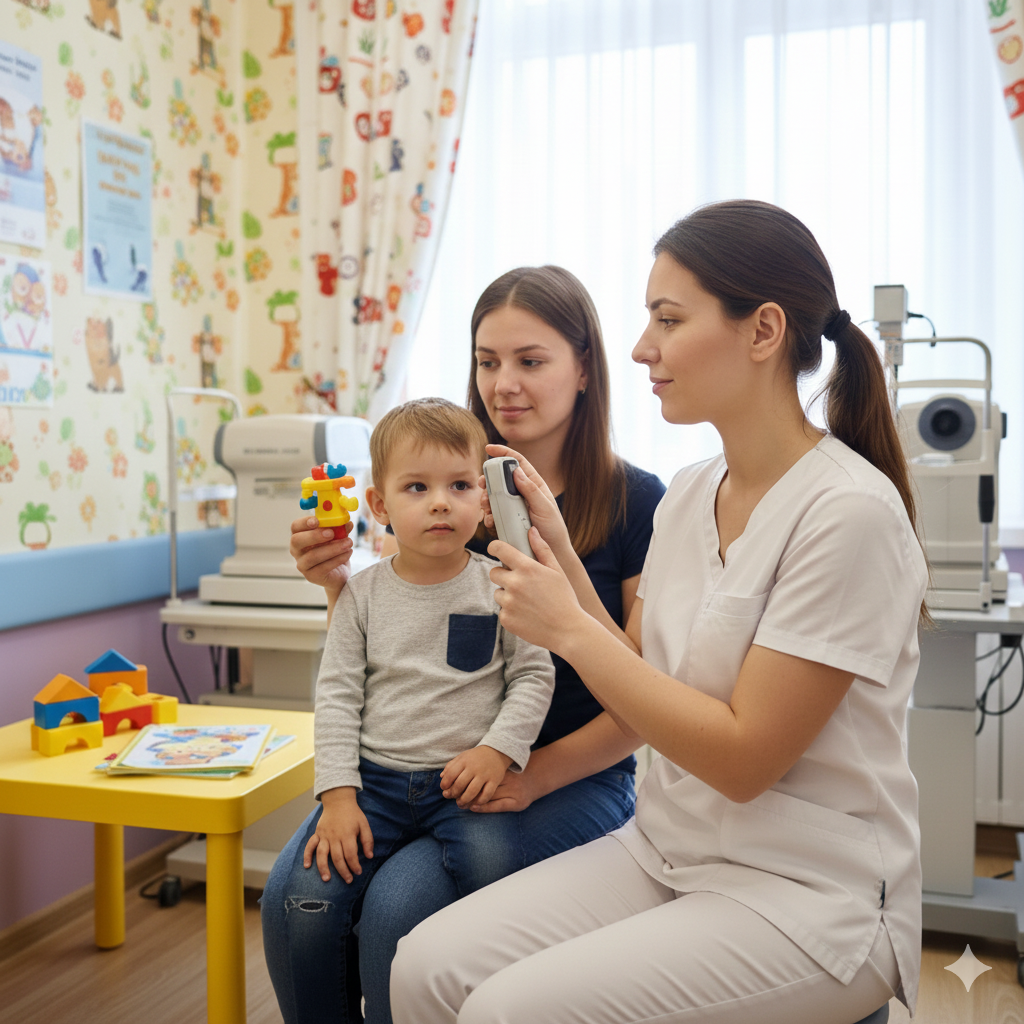
For many parents, the thought of an eye exam for a toddler is daunting. “How can they possibly check my child’s vision if they can’t read the chart?” It’s a completely valid question. The answer lies in the specialized techniques of a pediatric ophthalmologist near me.
Their exams rely on objective, non-verbal testing:
Photoscreeners and Autorefractors: These automated devices use light to quickly scan the eye and accurately measure the glasses prescription, even in a wiggling child.
Retinoscopy: The ophthalmologist uses a hand-held light to illuminate the eye and measure how light reflects off the retina, providing an exact measurement of Refractive Errors in children.
Dilation: Crucially, your child’s eyes will be dilated with drops. This is not just to see the retina; it temporarily paralyzes the eye’s focusing muscles. Children are such powerful focusers that without dilation, an ophthalmologist cannot get an accurate measurement of their true need for glasses.
Ultimately, your visit should be viewed as a preventative measure. Come prepared with a list of questions, including any family history of vision problems (especially Lazy Eye or high Near-sightedness in children), and trust in the process.
Conclusion: Investing in a Lifetime of Sight
A child’s vision is their primary tool for learning, socializing, and experiencing the world. Waiting until a child complains about their vision—or fails a school screening—is often waiting too long. Because of the limited nature of the critical period, early detection of conditions like Amblyopia, Strabismus, and advancing Myopia is the single greatest investment you can make in your child’s future well-being.
