

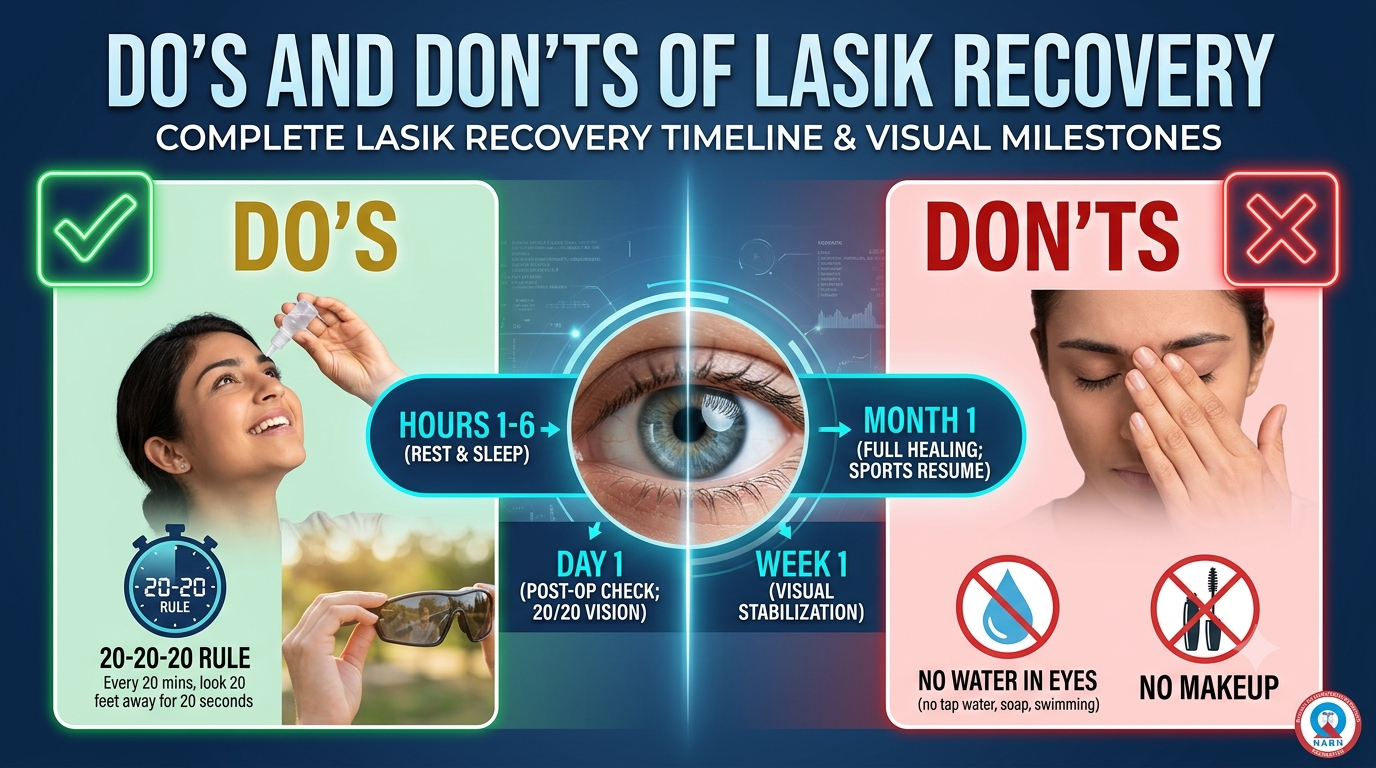
Undergoing laser vision correction is a life-changing milestone. The promise of waking up with effortless, crisp vision—free from the daily hassle of glasses or dry contact lenses—is exciting. However, once you step out of the operating suite, the success of your procedure depends heavily on how well you manage your recovery.
The human cornea heals with remarkable speed, but proper post-operative care is essential to ensure a smooth recovery. Knowing what to expect on a day-by-day basis helps reduce post-surgery anxiety and protects your eyes as they heal.
This guide provides a comprehensive recovery timeline, detailing visual milestones, symptom management, and critical “Do’s and Don’ts” to help you achieve optimal vision.
1. The Science of Corneal Healing After LASIK
To understand why post-operative care guidelines are so specific, it helps to look at how the eye heals following laser vision correction.
During Femto-LASIK or Contoura Vision, a ultra-thin corneal flap (typically 90 to 110 microns thick) is created using a femtosecond laser. The excimer laser reshapes the underlying stroma, and the flap is repositioned.
- Immediate Osmotic Alignment: The flap repositioning relies on natural endothelial fluid pumping and osmotic pressure to adhere without stitches. The perimeter epithelial cells begin sealing the edge within 6 to 12 hours.
- Nerve Desensitization & Regeneration: Creating the flap temporarily cuts microscopic nerve fibers in the superficial cornea. These nerves regulate natural blink rates and basal tear production. As a result, mild temporary dry eye is normal while these nerve endings regenerate over the next 3 to 6 months.
Knowing these biological phases explains why strict precautions—like avoiding eye rubbing and keeping tap water out of your eyes—are mandatory during early recovery.
2. Day-by-Day LASIK Recovery Timeline
Day 0: The First 24 Hours (The Critical Healing Window)
The first few hours immediately following surgery lay the foundation for your recovery.
What You Will Experience:
- The “Scratchy” Sensation: As the topical numbing eye drops wear off (usually 30 to 45 minutes post-op), you will experience mild burning, tearing, and a feeling like an eyelash or grain of sand is caught in your eye. This is completely normal.
- Light Sensitivity (Photophobia): Sunlight, overhead LED fixtures, and digital screens will feel intense.
- Hazy or “Underwater” Vision: Your vision will be significantly better than without glasses, but images may look like you are viewing them through a light fog or underwater.
Action Plan for Day 0:
- Sleep Immediately: Go straight home, close your blinds, and try to sleep for 4 to 6 hours. Sleeping keeps your eyelids closed, preventing blinking friction while the corneal epithelium seals its edges.
- Wear Protective Shields: Keep your clear protective eye shields on at all times, especially while sleeping, to prevent accidental eye rubbing.
- Instill Prescribed Drops: Begin your antibiotic and anti-inflammatory eye drops exactly as instructed by your surgeon once you wake up.
Day 1: The First Post-Operative Visit & The “Wow” Moment
For most patients, waking up on the morning after LASIK provides a striking transition.
What You Will Experience:
- Dramatic Visual Clarity: The haze from Day 0 clears significantly. Most patients achieve 20/20 or near 20/20 uncorrected visual acuity at their 24-hour checkup.
- Reduced Discomfort: The scratchy, burning sensation usually subsides, leaving mild dryness or eye fatigue.
- Subconjunctival Hemorrhages: You may notice small red patches or spots on the white part of your eye (sclera). These are harmless minor bruises caused by the suction ring during flap creation and fade naturally within 10 to 14 days.
What Happens at the Day 1 Clinic Check:
Your surgeon will evaluate your eyes under a slit-lamp microscope to confirm:
- The corneal flap is perfectly smooth, centered, and sealed without micro-wrinkles (striae).
- There are no signs of inflammation or infection.
- Your visual acuity meets target parameters.
Days 2 to 7 (Week 1): Visual Stabilization & Routine Adaptation
During the first week, your eyes continue their initial surface healing.
WEEK 1 SYMPTOM PATTERN
- Morning: Vision is crisp and clear
- Afternoon: Fluctuations begin during computer/screen work
- Evening: Mild halos around streetlights; dry eye fatigue
What You Will Experience:
- Minor Visual Fluctuations: Your vision may shift between hyper-sharp and slightly soft, especially after extended screen reading or in air-conditioned rooms.
- Night-Vision Artifacts: You may see halos, glare, or starbursts around headlights and streetlamps at night. This occurs as mild corneal swelling resolves and your pupil dilates in dark conditions.
- Mild Dry Eyes: You will need to use preservative-free artificial tears regularly to keep the surface lubricated.
Weeks 2 to 4: Returning to Normal Activity
By the second and third weeks, your corneal flap strength increases significantly, and your reliance on medicated drops decreases.
- Discontinuing Steroid Drops: You will taper off your anti-inflammatory and antibiotic drops according to your doctor’s schedule, continuing with preservative-free artificial tears.
- Night Halos Fade: Night-vision halos and glare gradually lessen as light scattering at the flap interface diminishes.
- Active Lifestyle Resumption: You can resume light jogging, gym workouts, and exercise routine, provided you keep sweat out of your eyes.
Months 1 to 3: Full Stabilization & Long-Term Results
Between 30 and 90 days post-surgery, your cornea reaches complete optical and neural stabilization.
- Corneal Nerve Re-Innervation: Sensory nerve fibers finish regenerating, restoring natural basal tear production and eliminating dry eye symptoms.
- Final Visual Confirmation: A follow-up visit confirms stable refraction, sharp contrast sensitivity, and healthy corneal topography.
3. The Ultimate LASIK Do’s and Don’ts
To ensure a smooth recovery, follow these essential guidelines during your healing period:
The Absolute DO’S
- DO Use Preservative-Free Lubricating Drops FrequentlyDo not wait until your eyes feel dry to apply drops. Using artificial tears every 1 to 2 hours during the first two weeks keeps the corneal surface smooth, reduces healing friction, and improves visual clarity.
- DO Wear Protective Eye Shields While SleepingWear your protective eye shields for the first 7 nights. Unconscious eye rubbing against a pillow during sleep is a leading cause of early flap dislocation.
- DO Wear 100% UV-Blocking Sunglasses OutdoorsHealing corneal tissue is sensitive to ultraviolet light. Wearing UV 400 sunglasses outdoors protects against glare, wind, and airborne debris while reducing UV-induced inflammation.
- DO Practice the 20-20-20 Rule for Screen WorkWhen working on screens, follow this simple habit: Every 20 minutes, look at an object 20 feet away for 20 seconds, and blink completely 3 to 4 times to refresh your tear film.
- DO Keep All Follow-Up AppointmentsEven if your vision feels 20/20 on Day 2, do not skip your scheduled 1-week, 1-month, and 3-month checkups. Your surgeon needs to verify flap alignment and corneal health under microscopic magnification.
The Critical DON’TS
- DON’T Rub Your Eyes (Strictly Prohibited for 4 to 6 Weeks)Rubbing your eye can dislodge, wrinkle, or shift the corneal flap before it has bonded fully, requiring a procedure to lift and smooth the flap. If your eye feels itchy, instill a cold lubricating drop instead.
- DON’T Get Tap Water, Soap, or Shampoo Directly in Your EyesFor the first 7 days, avoid letting water hit your face directly in the shower. Tap water carries microscopic organisms (such as Acanthamoeba) that can cause severe corneal infections while the flap margin is sealing. Wash your face gently with a damp washcloth, avoiding the eye area.
- DON’T Wear Eye Makeup for at Least 2 WeeksMascara, eyeliner, and eyeshadow harbor bacteria, and fine powder particles can settle beneath the corneal flap margin. Removing eye makeup also requires rubbing, which risks flap displacement.
- DON’T Swim, Use Hot Tubs, or Go to Saunas for 3 to 4 WeeksPools, oceans, lakes, hot tubs, and saunas contain bacteria and chemicals that can trigger severe ocular infections or corneal irritation.
- DON’T Engage in High-Impact Sports or Martial Arts for 1 MonthActivities with a risk of direct impact to the face (such as boxing, basketball, or martial arts) should be avoided for at least 4 weeks. When returning to sports, wear protective athletic eyewear.
- DON’T Drive Until Your Doctor Clears YouDo not drive on Day 0 or Day 1 until your surgeon officially verifies that your uncorrected visual acuity meets legal driving standards during your first post-op visit.
4. How to Manage Common Post-LASIK Side Effects
Understanding expected side effects helps you manage them calmly and effectively.
1. Dry Eye Management
- Why It Happens: Temporary desensitization of corneal nerves reduces reflex blink rate and tear film stability.
- Management: Use preservative-free lubricating drops regularly. If dryness persists into Week 3, consult your surgeon about adding an ointment at bedtime or using temporary punctal plugs to retain natural tears.
2. Halos, Glare, and Starbursts at Night
- Why It Happens: Mild post-operative corneal swelling combined with pupil dilation in low light.
- Management: Night halos typically resolve within 3 to 8 weeks. Avoid unlit highway driving during the first week, and keep your dashboard lights dim to reduce contrast glare.
3. Red Spots on the Sclera (Subconjunctival Hemorrhage)
- Why It Happens: Gentle pressure from the suction ring during flap creation can rupture a microscopic surface blood vessel on the white part of the eye.
- Management: This is cosmetic and completely painless. It does not affect vision and fades naturally without treatment within 2 weeks, like a minor bruise.
5. Warning Signs: When to Call Your Eye Surgeon Immediately
While serious complications are rare (occurring in less than 1% of patients), early detection is key. Contact your eye clinic immediately if you experience any of the following warning signs:
- Severe, Escalating Pain: Normal recovery involves mild scratchiness, not sharp, severe pain.
- Sudden Vision Loss: A sudden drop in visual acuity in one eye after it was previously clear.
- Thick Mucous Discharge: Yellowish or greenish discharge, accompanied by worsening redness or lid swelling, which can indicate infection.
- Accidental Eye Trauma: If your eye is struck or accidentally rubbed, resulting in sudden pain, watering, or distortion (indicating a potential flap displacement).
6. Recovery Comparison: LASIK vs. SMILE/SILK vs. PRK
Recovery experiences vary depending on the specific laser vision correction procedure performed:
| Parameter | Bladeless Femto-LASIK / Contoura | SMILE Pro / SILK (Flapless) | Surface PRK / TransPRK |
| Flap Created? | Yes (~20 mm perimeter flap) | No (2–3 mm keyhole micro-incision) | No (Epithelium removed) |
| Initial Visual Recovery | 24 Hours (Next-day functional vision) | 24 to 48 Hours | 5 to 7 Days (Requires bandage lens) |
| Post-Op Discomfort | Mild scratchiness (2–4 hours) | Minimal to none | Moderate pain/stinging (48–72 hours) |
| Eye Rubbing Restriction | Strict for 4 to 6 weeks | 1 to 2 weeks | 1 to 2 weeks |
| Flap Complication Risk | Small lifelong trauma risk | Zero | Zero |
| Dry Eye Duration | 1 to 3 months | Very short (1 to 3 weeks) | Short (1 to 4 weeks) |
7. Frequently Asked Questions (FAQs)
Q1: How soon can I return to computer work and office duties?
Most patients return to light desk work and screen usage 24 to 48 hours after Femto-LASIK or Contoura Vision. Remember to follow the 20-20-20 rule and apply lubricating eye drops frequently to prevent screen-induced dryness.
Q2: What happens if I accidentally rub my eye on Day 2?
Do not panic. If you accidentally touch your eye lightly, instill a cold lubricating drop and inspect your vision in a mirror. If you experience sudden sharp pain, persistent watering, or blurriness, contact your eye clinic immediately so your surgeon can check the flap under a microscope.
Q3: Can I wash my hair after LASIK?
Yes, but take precautions for the first 7 days. Tilt your head backward (salon-style) while showering to keep soapy water away from your face. Keep your eyes closed, and pat your face dry gently with a clean towel without rubbing your eyes.
Q4: Is it normal for one eye to see slightly clearer than the other during recovery?
Yes. Healing rates often differ slightly between eyes. One eye may reach sharp 20/20 clarity on Day 1, while the other takes 3 to 5 days to catch up. Minor asymmetry during the first few weeks is normal.
Q5: When can I wear contact lenses again if I need them for cosmetic reasons?
Colored or decorative contact lenses should be avoided for at least 2 to 3 months post-LASIK, and only worn after approval from your corneal specialist.
